ER-Positive, CDK4/6-Resistant, HER2-Mutant
What a HER2 mutation can mean in ER-positive disease after CDK4/6 resistance, including why HER2-negative pathology and HER2-mutant genomic testing can both be true
This page is for people with ER-positive breast cancer who respond to endocrine therapy, later progress on CDK4/6-based treatment, and then see a HER2 mutation on genomic testing.
That result often feels contradictory. Many people were previously told their cancer was HER2-negative.
Contents
Start here
How to use this page
This page is for people who were told they have ER-positive, HER2-negative or HER2-low disease, then later see a HER2 mutation on genomic testing.
Read it in this order:
The short version.
The two ways HER2 can be “positive.”
The working map after CDK4/6 resistance.
The strategy categories to watch.
If you do not have a HER2 mutation on sequencing, this page may still help explain one resistance route, but it may not be your route.
Overview
This page follows one resistance route in ER-positive disease.
It starts with a HER2 mutation and then explains how that route can recruit wider stress and survival programs.
Why this matters
ER-positive disease can escape treatment by switching on alternate growth pathways.
One important route is HER2-pathway activation. That can happen through classic HER2 overexpression or amplification. It can also happen through an activating HER2 mutation without amplification.
Once that escape route is active, it can feed broader receptor tyrosine kinase stress programs. Those may include EphA2 signaling, YAP/TAZ activity, and glutamine dependence.
Understanding the result
The short version
A tumour can be HER2-negative by standard pathology and still later show a HER2 mutation on genomic testing.
Those are not the same question.
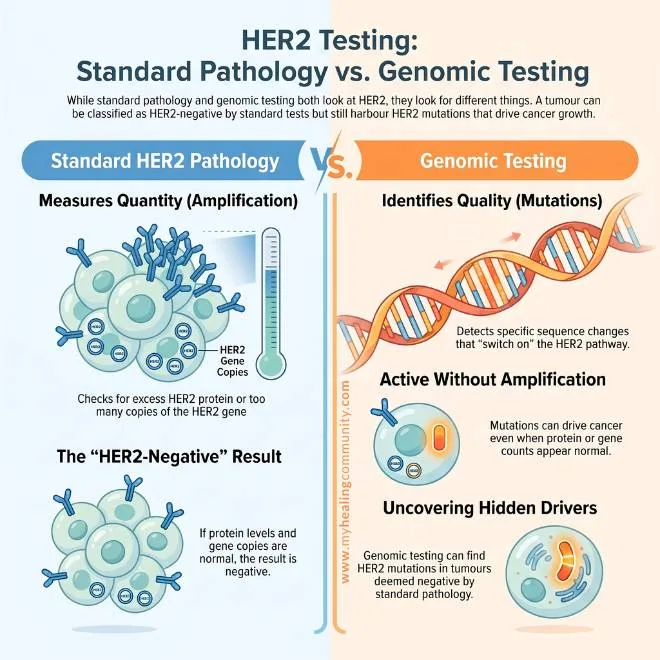
Standard HER2 pathology asks whether the tumour has too much HER2 protein or too many copies of the HER2 gene.
Genomic testing asks whether the HER2 gene itself has acquired an activating sequence change that can switch the pathway on even without amplification.
A HER2 mutation does not mean the original HER2-negative result was wrong.
It means a different layer of HER2 biology has been found.
What to check on your report
Look for:
ERBB2 or HER2 under mutations, variants, or genomic alterations.
A specific mutation name such as L755S, D769Y, V777L, or similar.
Wording such as activating mutation, pathogenic variant, or no ERBB2 alterations detected.
The test type: pathology such as IHC, ISH, or FISH versus genomic sequencing such as FoundationOne, Guardant, Tempus, or Caris.
A tumour can be HER2-negative on pathology and still carry a HER2 mutation on sequencing.
Quick glossary
Term | Plain-language meaning |
|---|---|
HER2 mutation | A DNA change in ERBB2/HER2 that can switch the pathway on even when standard HER2 tests are negative. |
RTK escape | The cancer starts relying more on growth-factor receptors than on its original hormone-driven route. |
EphA2 | A surface receptor that can amplify stress signaling and help resistant cells adapt. |
YAP/TAZ | Inside-the-cell regulators that help switch on survival programs. |
Glutamine dependence | A state where the tumour may rely more heavily on glutamine-related fuel handling. |
Two ways HER2 can be “positive”
HER2 overexpression or amplification
This is the classic HER2-positive result most patients know. It is usually found by pathology tests such as IHC and ISH/FISH.
These tissue tests measure how much HER2 protein is present and whether there are extra copies of the HER2 gene.
This is usually what most ER‑positive women are referring to when they say their cancer is HER2‑negative or HER2‑low.
HER2 mutation
This is different.
The tumour may still test HER2-negative on IHC or FISH, but DNA sequencing can show an activating mutation in ERBB2/HER2 that switches the pathway on.
That mutation can still drive resistance. It can also open treatment or trial options.
Why this feels contradictory
HER2-positive and HER2-negative are often taught as simple boxes.
In practice, there are two separate questions:
Is the tumour making too much HER2 protein or carrying HER2 amplification?
Is the HER2 gene mutated in a way that activates the pathway without amplification?
A patient can be no to the first question and yes to the second.
That is why a FoundationOne or similar result can feel confusing when it is really deeper biological information.
What this can mean after CDK4/6 resistance
This is still the same disease
This page does not mean the cancer has turned into a different diagnosis.
It is still the same ER-positive metastatic disease.
The HER2 mutation explains one escape route.
The EphA2-YAP/TAZ-glutamine section is included because it may help explain how that escape route becomes reinforced under treatment pressure.
A working map after CDK4/6 resistance
A simple pathway can look like this:
The cancer starts as ER-positive and initially responds to endocrine therapy, often with CDK4/6 inhibition.
Over time, resistant cells are selected.
The tumour acquires or reveals a HER2 mutation.
HER2 signaling feeds downstream pathways such as MAPK and PI3K.
Stress signaling can increase EphA2 expression and reduce clean hormone dependence.
EphA2 can help activate YAP/TAZ and strengthen glutamine use under treatment pressure.
Why this does not mean a different disease
Before going further, it helps to know that this is still the same resistance story.
The HER2 mutation explains one escape route.
The EphA2-YAP/TAZ-glutamine section explains one way that route may become stronger and more durable over time.
What RTK escape means
RTK escape means the cancer is relying less on the original hormone-driven route and more on growth-factor receptors for survival.
Those receptors are also called receptor tyrosine kinases, or RTKs.
In ER-positive disease, treatment pressure from endocrine therapy and CDK4/6 inhibitors can select for cells that use alternate receptors such as HER2, HER3, FGFR, or EphA2.
Those receptors can then feed downstream pathways such as MAPK/ERK and PI3K/Akt instead of cleaner ER signaling.
So when a HER2 mutation appears after progression, that is one example of RTK escape.
HER2 has acquired a change that lets it stay switched on even when standard HER2 tests were negative.
The cancer is not necessarily becoming a classic HER2-amplified tumour.
It is developing a mutation-driven HER2 route that bypasses cleaner ER dependence.
Where EphA2 fits
EphA2 is another receptor tyrosine kinase on the cell surface.
It normally helps cells sense their neighbours and organise themselves.
In cancer, it often gets repurposed.
In the HER2-mutant, ER-positive setting, EphA2 is best understood as a stress-amplifying hub rather than the first driver of the disease.
HER2 and other growth-factor receptors signal through cascades such as MAPK/ERK and PI3K/Akt.
When those cascades stay active under treatment pressure, they can push EphA2 levels up.
Once EphA2 is high, it adds another layer of survival signaling.
In breast-cancer models, EphA2 has been shown to activate YAP/TAZ and increase glutamine transport and glutaminase activity.
That gives the cell extra ways to fuel itself.
Put simply, the HER2 mutation can switch on a bypass route.
EphA2 can then help that route harden into a more durable survival state by linking outside-the-cell growth signals to inside-the-cell programs such as YAP/TAZ activity and glutamine use.
A simple way to think about this
The HER2 mutation may be the trigger.
EphA2, YAP/TAZ, and glutamine dependence may be part of the adaptation program the cell builds around that trigger.
Not every HER2-mutant tumour will use this branch to the same degree.
It is one biologically plausible route being watched in resistant disease.
For the wider condensate, fibrosis, and YAP/TAZ framing, see Phase Separation in Oncology, Fibrotic Drivers and the 26-Gene Signature, or the Melatonin in Oncology - Study Notes hub.
A HER2 mutation after CDK4/6 resistance is still the same ER-positive metastatic disease.
RTK escape does not mean a different diagnosis.
It means the same cancer has found a different survival route.
What this does and does not mean
This does not mean every HER2-mutant tumour is automatically EphA2-driven or glutamine-dependent.
It means researchers are watching whether some resistant HER2-mutant tumours recruit this wider survival branch.
That matters because it may help explain why the disease becomes harder to switch off and why several strategy categories are being explored at the same time.
Treatment and research options
Why this matters for care and research
A HER2 mutation is not just a label.
It can create new treatment, trial, and monitoring questions that were not visible when the cancer was described only as ER-positive and HER2-negative.
That is why the exact mutation name, the test type, and the timing of the result can all matter.
What this result may point to biologically
ER-positive disease with endocrine and CDK4/6 resistance can shift away from clean ER dependence and toward bypass survival pathways.
A HER2 mutation despite HER2-negative pathology can mean HER2 signaling is now mutation-driven rather than amplification-driven.
HER2 mutation plus RTK escape signaling can point to broader MAPK, PI3K, and stress-adaptation programs.
HER2 mutation plus EphA2, YAP/TAZ, or glutamine features can suggest a more stress-adapted phenotype using receptor escape and metabolic compensation.
Strategy categories to watch
HER2 tyrosine kinase inhibitors
Some activating HER2 mutations show sensitivity to HER2-targeted tyrosine kinase inhibitors such as neratinib or afatinib.
Response can depend on the exact mutation. That is one reason the specific mutation name matters.
Neratinib-based strategies have also been studied in HER2-mutant, HR-positive breast cancer, including combinations used in the SUMMIT program.
Neratinib in HER2-mutant disease
Neratinib is an oral, irreversible pan-HER tyrosine kinase inhibitor.
It has shown activity in HER2-mutant tumours, including HR-positive metastatic breast cancer. For background reading, start with this PubMed Central search for neratinib in HER2-mutant breast cancer.
In the SUMMIT basket trial, neratinib-based strategies were studied in HR-positive, HER2-mutant, HER2-non-amplified metastatic breast cancer after progression on CDK4/6 inhibitors. You can open PubMed results for the SUMMIT neratinib combination studies here.
In heavily pre-treated patients, the combination of neratinib + fulvestrant + trastuzumab produced a confirmed objective response rate of about 39% and a median progression-free survival of about 8 months.
These results helped put neratinib-based regimens into major guidelines for a molecularly defined group of patients with activating HER2 / ERBB2 mutations.
That does not mean neratinib is right for every person with a HER2 mutation.
It does mean that when an activating HER2 / ERBB2 mutation appears on sequencing, there may be specific data, trial options, and guideline-supported discussions for you and your oncologist to review together.
Useful reading
Expert discussion of neratinib + fulvestrant + trastuzumab, including updates from Dr Komal Jhaveri on ecancer
Video search for neratinib and HER2-mutant metastatic breast cancer updates on YouTube
Guideline-linked summaries covering neratinib-based regimens for HER2-mutant breast cancer
Dual ER and HER2 targeting
If the tumour remains ER-positive but has activated HER2 escape signaling, there is clear logic to combining endocrine therapy with HER2-directed treatment.
This is especially relevant when the disease no longer behaves like straightforward endocrine-sensitive ER-positive cancer.
Trials after CDK4/6 resistance
CDK4/6 resistance in HR-positive disease often involves alternate receptor signaling, cell-cycle escape, and metabolic adaptation.
A HER2 mutation found after progression is exactly the kind of result that can support a search for basket trials, HER2-mutant trials, or mechanism-guided combination studies.
Glutaminase inhibition and metabolic vulnerability
The EphA2-YAP/TAZ branch matters because it suggests some HER2-mutant resistant tumours may become more dependent on glutamine handling.
That makes glutaminase inhibition a research angle worth watching, especially when RTK escape and YAP/TAZ biology are also in view.
A note on natural compounds and glutaminase claims
This area needs caution.
Many community discussions mention natural compounds that may affect metabolism, stress signaling, or YAP/TAZ tone. The integrative formulas like Glutamine Inhibifour are designed to support resilience and potentially tilt metabolism, not to replace the evidence core of HER2/RTK‑directed therapies and emerging glutaminase‑inhibition approaches.
Integrative strategies may still play a supportive role around resilience, symptom burden, and broader metabolic context.
However, in this specific setting, the evidence core still sits with mutation-matched oncology care, HER2/RTK-directed treatment, clinical-trial exploration, and emerging glutamine-targeted research.
Melatonin is already known to modulate glutamine handling in some tissues, to reshape stress signalling cascades such as ER stress and MAPK/PI3K, and to interact with the Hippo/YAP pathway in experimental models. The Loh et al. work makes it a plausible candidate for influencing YAP/TAZ condensate behaviour and glutamine‑linked survival programs, even though direct, clinical‑grade data in ER‑positive breast cancer are not yet available
However, the clearest evidence in HER2-mutant, RTK-escaped, glutamine-dependent disease still comes from targeted drugs and preclinical glutaminase-inhibition models.
Practical next steps
Plain-language take-home
A patient can start with ER-positive disease, become resistant to CDK4/6 treatment, and later discover a HER2 mutation on a test like FoundationOne that older-style HER2 testing did not show.
That does not mean the earlier diagnosis was wrong.
It means the cancer may have revealed a deeper escape pathway. That pathway can connect HER2 signaling to EphA2, YAP/TAZ activity, and glutamine dependence.
Other ctDNA tests readers may come across
FoundationOne is only one example of this kind of testing.
Other names include Guardant360, Tempus xF, Caris Assure, and, in some settings, Signatera, Guardant Reveal, or Exacta (DATAR Cancer Genetics).
These tests are not all used for exactly the same purpose.
Some are used mainly to look for actionable mutations in advanced cancer.
Others are used more for monitoring, molecular residual disease, or recurrence tracking over time.
Some services, such as Exacta, combine blood-based profiling with deeper tissue and expression analysis
What matters most is that your oncologist agrees the test is the right kind of ctDNA assay for your situation and that the report can be used to help guide treatment decisions.
There may be other platforms and newer ones emerging over time.
Questions to ask your oncologist
Was HER2 assessed only by pathology, or also by sequencing?
Does my report show an ERBB2 / HER2 mutation?
Does my report show an activating HER2 / ERBB2 mutation?
If yes, what is the exact mutation name?
Does this result change treatment or trial options?
Have neratinib-based strategies, including the SUMMIT approach, been considered in cases like mine?
Are there trials or guideline-supported options for my specific HER2 mutation and treatment history?
Would repeat ctDNA testing be useful later if resistance continues?
Related pages to support insight and action
Blood Biopsy Trial — Getting Ahead of Treatment Resistance — useful when the next question is how to track evolving resistance earlier. It helps frame where repeat ctDNA testing may or may not catch a new escape route such as HER2 mutation.
FGFR1 Amplification in ER+ Breast Cancer — another example of ER-positive disease shifting into a bypass pathway under endocrine pressure. It helps show where these HER2 mutations are part of a broader resistance pattern, not a one-off exception.
Phase Separation in Oncology — the deeper page for readers who want the YAP/TAZ and stress-adaptation model mentioned on this HER2 mutation page. It helps explain how signalling escape can stabilise more durable survival states rather than acting like a single isolated mutation event.
Melatonin in Oncology - Study Notes — useful for readers who want the broader melatonin framework behind the YAP/TAZ, phase-separation, immune, and dosing themes touched on in resistant ER-positive disease.
This information is for education only. It is not medical advice, diagnosis, or treatment. Please speak with a qualified clinician before making changes to care, medication, or supplement use.
© 2026 Abbey Mitchell. All rights reserved. Please share by URL rather than copying page text.