Andrographis in ER-Positive Breast Cancer
Plain-language guide to andrographolide in ER-positive breast cancer, including ERα downregulation, fulvestrant synergy, resistance questions, and bone-axis overlap.
Andrographis keeps surfacing in ER-positive discussions for one reason.
Its main compound, andrographolide, appears to push down ERα signalling in preclinical models.
That can look promising. It can also raise fair questions about resistance pressure, receptor loss, and long-term tradeoffs.
This remains a preclinical topic. There are no human oncology trials showing how andrographis behaves in ER-positive breast cancer treatment. Use extra caution with endocrine therapy, SERDs, CDK4/6 inhibitors, and any supplement with possible drug interactions.
Why this page exists
This topic used to sit inside the bone-metastasis notes because andrographolide also has bone-axis relevance.
It now has its own page because the ER-positive receptor and resistance questions need their own context.
Related reading:
At a glance
Short-term logic: less ERα may mean less ER-driven growth.
Best-supported pairing: preclinical synergy is strongest with fulvestrant.
Main concern: long-term ER suppression can select for escape routes.
Big limit: no one knows the human dose, durability, or clinical risk-benefit yet.
Why it also appears in bone-metastasis discussions
Andrographolide has preclinical evidence in the RANKL–NF-κB bone pathway.
In bone models, it appears to:
suppress NF-κB and ERK/MAPK signalling during osteoclast formation
reduce NFATc1, c-Fos, cathepsin K, and MMP-9
inhibit cancer-driven osteolysis in breast-cancer bone models
It has also shown osteoblast-supportive effects in animal work.
That dual pattern is why it gets discussed in bone-metastasis support notes. It does not make it equivalent to denosumab or bisphosphonates.
The core preclinical finding
The central ER-positive paper is:
Andrographolide Inhibits ER-Positive Breast Cancer Growth and Enhances Fulvestrant Efficacy via ROS-FOXM1-ER-α Axis
&#xNAN;Frontiers in Oncology (2022)
https://pmc.ncbi.nlm.nih.gov/articles/PMC9124841/
The paper reports that andrographolide suppresses ESR1 transcription through the ROS–FOXM1–ERα axis.
In ER-positive models, that lowered ERα signalling, slowed tumour growth, and improved fulvestrant activity.
For the wider FOXA1 and FOXM1 context in ER-positive metastatic disease, see FOX Family in ER+ Metastatic Breast Cancer.
For the wider FOXM1 angle in metastasis and bone biology, see FOXM1 in Bone Metastasis.
What makes people pause
The concern is not trivial.
If a compound pushes ERα down hard enough, could it help select for disease that behaves more like ER-low or ER-negative escape?
Current evidence does not show that andrographolide automatically flips ER-positive disease into classic triple-negative breast cancer.
That said, any strong ER suppression can change tumour evolution over time.
ERα downregulation is a double-edged sword
Short term: less ERα may reduce ER-driven proliferation and improve response to SERDs.
Long term: a subset of tumours can adapt by leaning less on ER and more on other pathways.
Clinical endocrine-resistance patterns suggest that most resistant tumours do not convert cleanly into classic TNBC.
More often, they stay partly ER-positive while shifting dependence toward pathways such as:
PI3K/AKT/mTOR
MAPK
FGFR and related RTK signalling
cyclin E–CDK2 and other cell-cycle escape routes
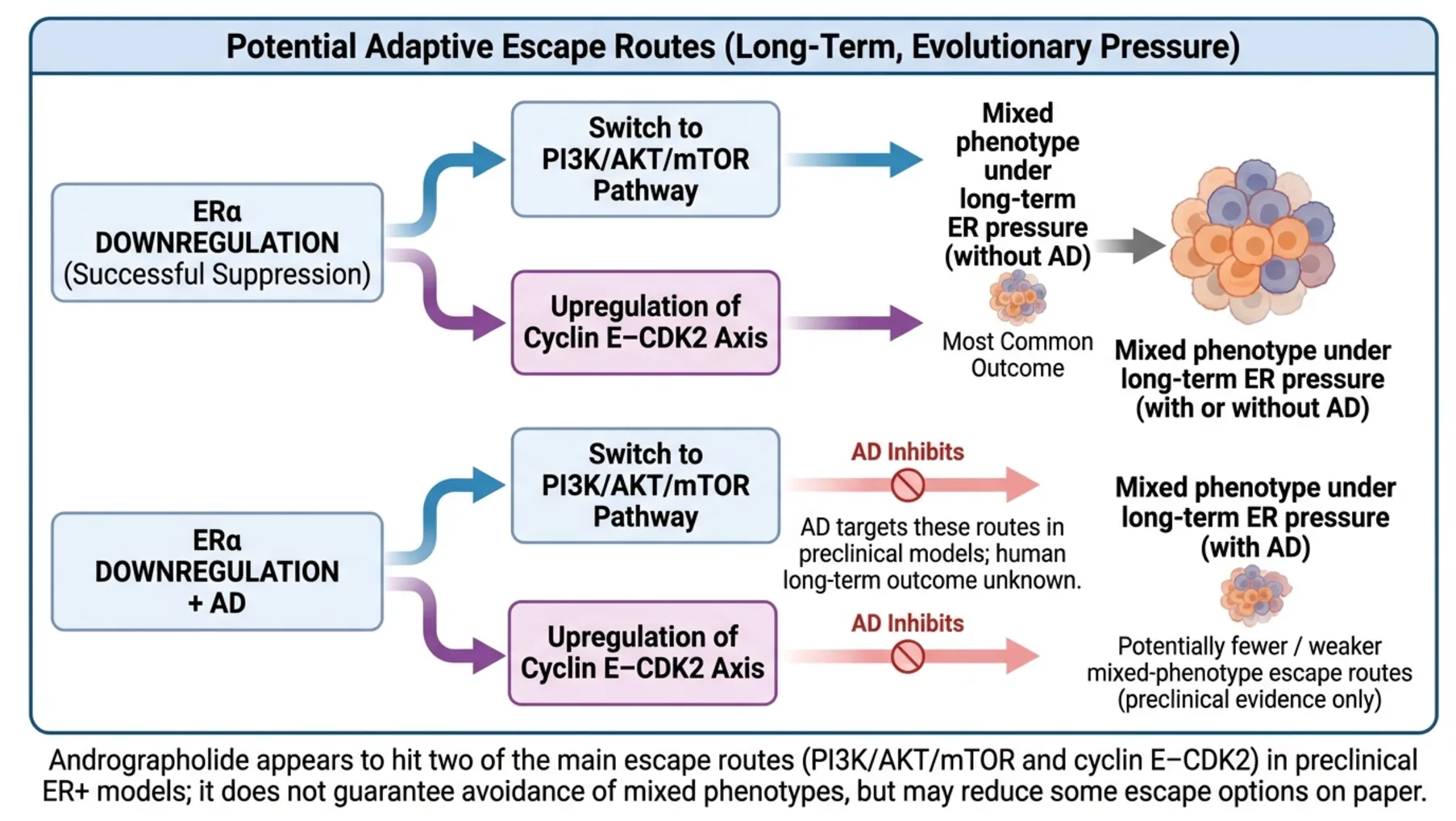
Scenario 1 — Andrographis lowers ERα without a SERD
This is the most uncertain use case.
If someone is on an AI, or an AI plus CDK4/6 inhibitor, andrographolide could theoretically deepen ER suppression.
In the short term, that may reinforce the endocrine block.
Over time, the more likely concern is not a clean subtype flip. The concern is selection pressure.
Possible adaptive routes include:
Partial ER loss with preserved growth through PI3K, MAPK, or FGFR-style signalling.
ER-low heterogeneity where staining stays positive but functional ER dependence weakens.
Cell-cycle escape through cyclin E–CDK2 and related bypass programs.
Preclinical reports suggest andrographolide also hits some of these same escape networks. That includes PI3K/AKT/mTOR, ERK/MAPK, and several cyclin-CDK controls.
That broader network reach is interesting. It is still not a clinical proof point.
Scenario 2 — Andrographis added to fulvestrant
This is closest to what the Xu paper actually tested.
The model is straightforward:
andrographolide reduces ESR1 transcription
fulvestrant accelerates ERα protein degradation
In vitro and in mouse xenografts, the pairing looked strongly synergistic.
That supports the idea that andrographolide may act as a fulvestrant sensitiser in preclinical ER-positive disease.
The same caution still applies. If ER suppression becomes deeper and more durable, resistant clones may still emerge through non-ER pathways.
So the likely tradeoff is not “creates TNBC” versus “does not create TNBC.” The real issue is whether stronger ER pressure improves control enough to justify the escape pressure it may also create.
Does this mean TNBC conversion?
Not usually.
Across endocrine-resistance literature, only a minority of initially ER-positive cancers become fully ER-negative at recurrence.
A rough range often cited is 10% to 25%.
Most resistant tumours remain ER-positive on staining, but behave less like cleanly ER-dependent disease.
That is why re-biopsy at progression matters when feasible.
How strong was the ERα inhibition?
The paper measured ERα reduction.
It did not give a simple clinical-style percentage that lets you compare andrographolide directly with fulvestrant or oral SERDs.
The signal was shown mainly through Western blots, mRNA changes, and dose-dependent reductions in ER-positive cell lines.
The clean takeaway is this:
Andrographolide clearly pushed ERα and ESR1 down in the lab. Combined with fulvestrant, it pushed them down further.
What that means for real human dosing remains unknown.
Practical takeaways
Treat this as a mechanistic lead, not a treatment-standard shortcut.
Stronger ER suppression may help initially.
Stronger ER suppression may also increase evolutionary pressure.
Monitoring receptor status over time matters more than simple labels.
Combination logic matters more than single-agent enthusiasm.
References
ER-positive andrographolide paper
Xu et al. Andrographolide Inhibits ER-Positive Breast Cancer Growth and Enhances Fulvestrant Efficacy via ROS-FOXM1-ER-α Axis.
https://pmc.ncbi.nlm.nih.gov/articles/PMC9124841/
Resistance and escape-pathway context
Mechanisms of CDK4/6 Inhibitor Resistance in Luminal Breast Cancer.
https://pmc.ncbi.nlm.nih.gov/articles/PMC7751736/The Prowess of Andrographolide as a Natural Weapon in the War against Cancer.
https://pmc.ncbi.nlm.nih.gov/articles/PMC7465495/Endocrine Therapy Resistance and Receptor Change in Breast Cancer.
https://www.explorationpub.com/Journals/etat/Article/100296
Bone-axis overlap
Andrographolide suppresses RANKL-induced osteoclastogenesis via NF-κB and ERK/MAPK pathways.
https://pmc.ncbi.nlm.nih.gov/articles/PMC3969079/Inhibition of MDA-MB-231 breast cancer cell migration and invasion and suppression of tumour-induced osteolysis by andrographolide.
https://pubmed.ncbi.nlm.nih.gov/25374279/Andrographolide stimulates osteoblastogenesis and bone formation via inhibition of NF-κB signalling.
https://pmc.ncbi.nlm.nih.gov/articles/PMC6896731/
Sources mentioned in community discussions
Terry Naturally, Andrographis EP80
https://au.iherb.com/pr/terry-naturally-andrographis-ep80-400-mg-60-capsules/102372Botanicals For Life Organic Alcohol-Free Andrographis Extract
https://www.bodykind.com/supplements-c11/herbal-licensed-remedies-c42/andrographis-c501/uk-made-t7